Solution · Music
Agentic AI Master Data Management for the Music Industry with Merge: From Fragmented Catalogs to Unified Artist Intelligence
How identity-based resolution, agentic AI matching, and graph traversal turn scattered music metadata into a unified master data platform.
The Multi-Platform Music Data Problem
Every music-tech company faces the same fragmentation challenge. The Weeknd appears on Spotify as "The Weeknd" with genre "R&B/Pop." Apple Music lists him as "The Weeknd" under "R&B." Tidal catalogs "Jay-Z" while Spotify has "Jay-Z" and a fan wiki writes "Jay Z" without the hyphen. Ticketmaster sells tickets for "Coachella" while Wikipedia references "Coachella Valley Music and Arts Festival."
Same artist, same venue, same label — but your database sees six different entries where there should be one.
Multiply this across thousands of artists, hundreds of thousands of albums, venue partnerships, label rosters, and touring schedules, and you're looking at a metadata nightmare. Traditional deduplication — exact string matching, manual curation, or rigid ETL rules — cannot keep up with the volume, velocity, and inconsistency of music industry data.
This is the problem Merge solves. In this post, we'll walk through building a complete music industry master data graph that:
- Ingests artist, album, label, and venue records from multiple platforms simultaneously
- Automatically merges records that share a verified identity key (like a Spotify artist ID)
- Uses agentic AI to evaluate uncertain matches and route ambiguous cases for human review
- Creates a traversable relationship graph connecting artists to labels, albums, venues, and collaborators
- Handles search with typo tolerance so "Kendrik Lamarr" still finds Kendrick Lamar
By the end, you'll see how 24 raw source records become clean golden entities connected by 23 relationship edges — with rich multi-hop graph traversal revealing hidden connections like shared labels and venues.
Schema Design: Identity Keys for Deterministic Resolution
Before ingesting any data, we define our entity schemas. The critical design decision: which fields get marked with identity: true. An identity field tells Merge that when two records share the same value in that field, they are definitively the same entity and should be merged automatically — no AI evaluation needed.
Entity Schemas
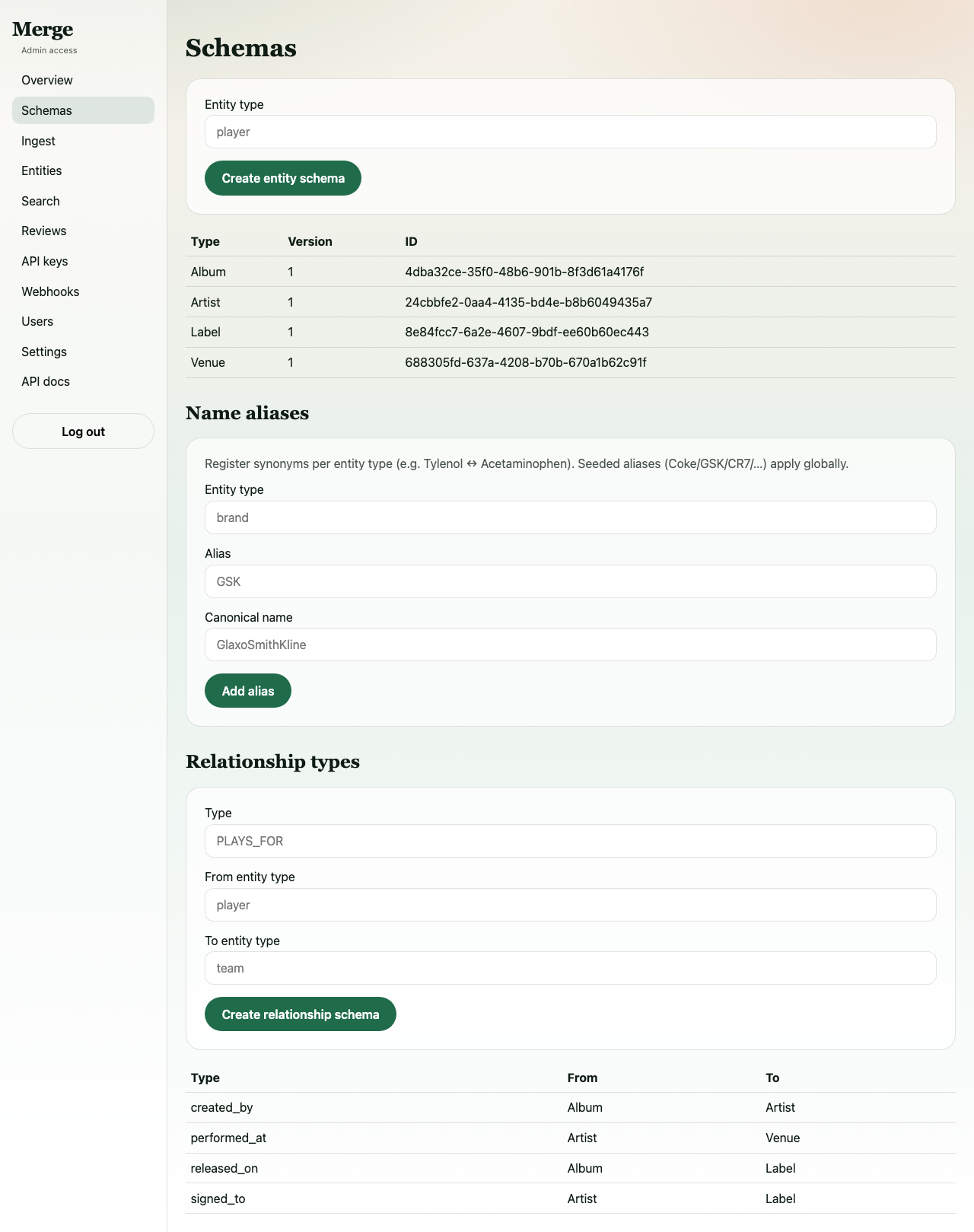
We define four entity types. Artist and Album include identity fields because music platforms assign stable external identifiers (Spotify IDs, ISRC codes, etc.):
# Artist schema — external_id is the identity key
curl -X POST https://merge-ai.app/v1/schemas \
  -H "X-API-Key: YOUR_API_KEY" \
  -H "Content-Type: application/json" \
  -d '{
    "entity_type": "Artist",
    "attributes": [
      { "name": "name", "type": "string", "required": true },
      { "name": "genre", "type": "string" },
      { "name": "origin", "type": "string" },
      { "name": "active_since", "type": "string" },
      { "name": "external_id", "type": "string", "identity": true }
    ]
  }'
# Album schema — also with identity key
curl -X POST https://merge-ai.app/v1/schemas \
  -H "X-API-Key: YOUR_API_KEY" \
  -H "Content-Type: application/json" \
  -d '{
    "entity_type": "Album",
    "attributes": [
      { "name": "title", "type": "string", "required": true },
      { "name": "release_year", "type": "string" },
      { "name": "genre", "type": "string" },
      { "name": "external_id", "type": "string", "identity": true }
    ]
  }'
# Label schema — no identity key (resolved by name similarity)
curl -X POST https://merge-ai.app/v1/schemas \
  -H "X-API-Key: YOUR_API_KEY" \
  -H "Content-Type: application/json" \
  -d '{
    "entity_type": "Label",
    "attributes": [
      { "name": "name", "type": "string", "required": true },
      { "name": "parent_company", "type": "string" },
      { "name": "headquarters", "type": "string" }
    ]
  }'
# Venue schema — no identity key
curl -X POST https://merge-ai.app/v1/schemas \
  -H "X-API-Key: YOUR_API_KEY" \
  -H "Content-Type: application/json" \
  -d '{
    "entity_type": "Venue",
    "attributes": [
      { "name": "name", "type": "string", "required": true },
      { "name": "city", "type": "string" },
      { "name": "capacity", "type": "string" },
      { "name": "venue_type", "type": "string" }
    ]
  }'
Why Identity Matters for Music Data
The identity: true flag on external_id tells Merge: "If two records share the same value in this field, they are definitively the same entity — merge them instantly, no questions asked."
This maps perfectly to how the music industry works. When Spotify assigns artist ID SPOT-1Xyo to The Weeknd, and Apple Music references that same ID in their catalog feed, Merge knows instantly they represent the same artist. No AI inference needed, no review queue delay — just immediate, deterministic unification.
For Labels and Venues, we intentionally omit identity keys. These entities don't have universal cross-platform identifiers, so Merge relies on its agentic AI layer to evaluate similarity when potential duplicates arrive.
| Schema | Identity Field | Resolution Behavior |
|---|---|---|
| Artist | external_id |
Same ID → instant auto-merge |
| Album | external_id |
Same ID → instant auto-merge |
| Label | (none) | AI evaluates name + attributes |
| Venue | (none) | AI evaluates name + location |
Relationships: The Connectivity Model
Entities in isolation are metadata. Entities connected by relationships become a master data graph. We define four relationship types that capture the core structure of the music industry:
# Artist signed to Label
curl -X POST https://merge-ai.app/v1/relationships \
  -H "X-API-Key: YOUR_API_KEY" \
  -H "Content-Type: application/json" \
  -d '{ "name": "signed_to", "from_type": "Artist", "to_type": "Label" }'

# Album released on Label
curl -X POST https://merge-ai.app/v1/relationships \
  -H "X-API-Key: YOUR_API_KEY" \
  -H "Content-Type: application/json" \
  -d '{ "name": "released_on", "from_type": "Album", "to_type": "Label" }'

# Album created by Artist
curl -X POST https://merge-ai.app/v1/relationships \
  -H "X-API-Key: YOUR_API_KEY" \
  -H "Content-Type: application/json" \
  -d '{ "name": "created_by", "from_type": "Album", "to_type": "Artist" }'

# Artist performed at Venue
curl -X POST https://merge-ai.app/v1/relationships \
  -H "X-API-Key: YOUR_API_KEY" \
  -H "Content-Type: application/json" \
  -d '{ "name": "performed_at", "from_type": "Artist", "to_type": "Venue" }'
Multi-Hop Discovery Paths
These four relationship types enable powerful multi-hop graph traversal. Starting from any album, you can trace outward to discover connections that would be invisible in a flat database:
Album → created_by → Artist → performed_at → Venue ← performed_at ← (other artists)
  │                    │
  └── released_on ──→ Label ←── signed_to ←── (other artists on same label)
For example, starting from the album "After Hours":
- Hop 1: After Hours → created_by → The Weeknd
- Hop 2: The Weeknd → signed_to → XO Records; The Weeknd → performed_at → Coachella
- Hop 3: XO Records ← signed_to ← Drake; Coachella ← performed_at ← Kendrick Lamar
One query reveals that Drake and The Weeknd are labelmates, and that Kendrick Lamar performed at the same festival. These connections emerge naturally from the graph structure without any manual curation.
Loading Connected Data
With schemas and relationships defined, we ingest records from multiple sources. Each entity arrives with its relationships, building the graph as data flows in.
Labels
# Ingest record labels
curl -X POST https://merge-ai.app/v1/entities \
  -H "X-API-Key: YOUR_API_KEY" \
  -H "Content-Type: application/json" \
  -d '{
    "entity_type": "Label",
    "attributes": {
      "name": "XO Records",
      "parent_company": "Republic Records",
      "headquarters": "Toronto"
    },
    "source": "music_db"
  }'

# Additional labels: Interscope, Parlophone, Roc Nation
We load four labels: XO Records (Republic/Universal), Interscope Records (Universal Music Group), Parlophone Records (Warner Music Group), and Roc Nation (Live Nation).
Venues
# Ingest performance venues
curl -X POST https://merge-ai.app/v1/entities \
  -H "X-API-Key: YOUR_API_KEY" \
  -H "Content-Type: application/json" \
  -d '{
    "entity_type": "Venue",
    "attributes": {
      "name": "Madison Square Garden",
      "city": "New York",
      "capacity": "20789",
      "venue_type": "Arena"
    },
    "source": "music_db"
  }'

# Additional venues: Coachella, Glastonbury, Wembley Stadium
Four iconic venues: Madison Square Garden (Arena, NYC), Coachella Valley Music and Arts Festival (Festival, Indio), Glastonbury Festival (Festival, Somerset), and Wembley Stadium (Stadium, London).
Artists with External IDs
Here's where the identity resolution story begins. Each artist carries an external_id matching their Spotify artist identifier, plus relationships to their label and primary performance venue:
# The Weeknd — from Spotify catalog
curl -X POST https://merge-ai.app/v1/entities \
  -H "X-API-Key: YOUR_API_KEY" \
  -H "Content-Type: application/json" \
  -d '{
    "entity_type": "Artist",
    "attributes": {
      "name": "The Weeknd",
      "genre": "R&B/Pop",
      "origin": "Toronto",
      "active_since": "2009",
      "external_id": "SPOT-1Xyo"
    },
    "source": "spotify",
    "relationships": [
      { "relationship_type": "signed_to", "to_entity_id": "ent_xo_records_id" },
      { "relationship_type": "performed_at", "to_entity_id": "ent_coachella_id" }
    ]
  }'
We ingest six artists from the Spotify catalog feed:
| Artist | Genre | External ID | Label | Venue |
|---|---|---|---|---|
| The Weeknd | R&B/Pop | SPOT-1Xyo | XO Records | Coachella |
| Kendrick Lamar | Hip-Hop | SPOT-2YZy | Interscope Records | Coachella |
| Jay-Z | Hip-Hop | SPOT-3nFk | Roc Nation | Madison Square Garden |
| Billie Eilish | Pop/Electropop | SPOT-6qqN | Interscope Records | Glastonbury Festival |
| Coldplay | Alternative Rock | SPOT-4gzp | Parlophone Records | Wembley Stadium |
| Drake | Hip-Hop/R&B | SPOT-3TVX | XO Records | Madison Square Garden |
Albums with Relationships
Each album links to its artist (created_by) and its label (released_on):
# After Hours — linked to The Weeknd and XO Records
curl -X POST https://merge-ai.app/v1/entities \
  -H "X-API-Key: YOUR_API_KEY" \
  -H "Content-Type: application/json" \
  -d '{
    "entity_type": "Album",
    "attributes": {
      "title": "After Hours",
      "release_year": "2020",
      "genre": "Synth-pop/R&B",
      "external_id": "ALB-AH2020"
    },
    "source": "spotify",
    "relationships": [
      { "relationship_type": "created_by", "to_entity_id": "ent_weeknd_id" },
      { "relationship_type": "released_on", "to_entity_id": "ent_xo_records_id" }
    ]
  }'
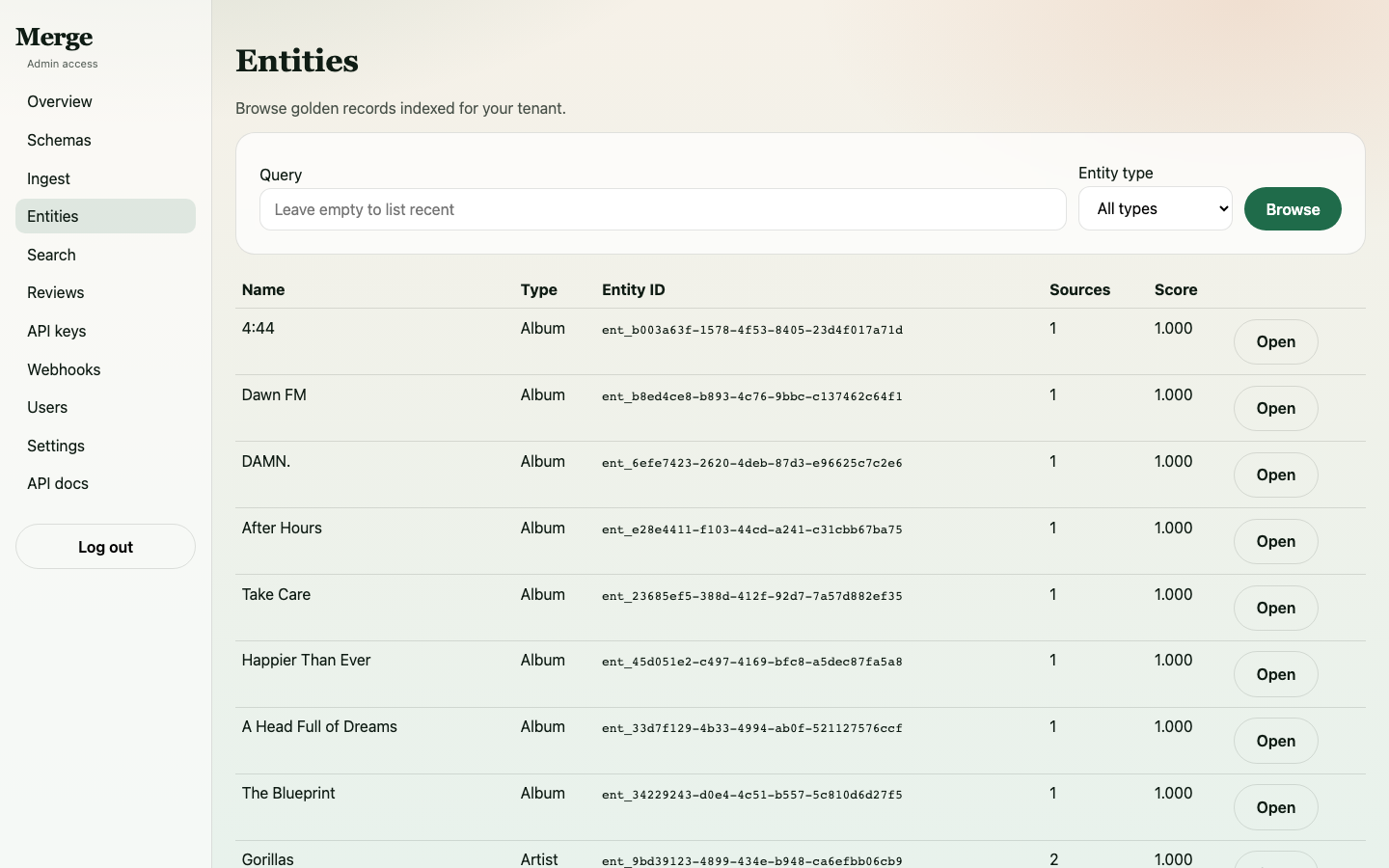
Eight albums across the roster:
| Album | Year | Artist | Label |
|---|---|---|---|
| After Hours | 2020 | The Weeknd | XO Records |
| Dawn FM | 2022 | The Weeknd | XO Records |
| DAMN. | 2017 | Kendrick Lamar | Interscope Records |
| 4:44 | 2017 | Jay-Z | Roc Nation |
| Happier Than Ever | 2021 | Billie Eilish | Interscope Records |
| A Head Full of Dreams | 2015 | Coldplay | Parlophone Records |
| Take Care | 2011 | Drake | XO Records |
| The Blueprint | 2001 | Jay-Z | Roc Nation |
Identity Auto-Merge: When the Same Artist Arrives from a Different Platform
Now we demonstrate the core identity resolution capability. The Weeknd already exists from the Spotify feed with external_id: "SPOT-1Xyo". What happens when Apple Music sends us their version of the same artist?
The Weeknd from Apple Music
# Same artist, different source, same external_id
curl -X POST https://merge-ai.app/v1/entities \
  -H "X-API-Key: YOUR_API_KEY" \
  -H "Content-Type: application/json" \
  -d '{
    "entity_type": "Artist",
    "attributes": {
      "name": "The Weeknd",
      "genre": "R&B",
      "origin": "Toronto, Canada",
      "active_since": "2009",
      "external_id": "SPOT-1Xyo"
    },
    "source": "apple-music"
  }'
Because both records carry external_id: "SPOT-1Xyo" and the Artist schema marks external_id with identity: true, Merge instantly recognizes these as the same entity. No AI evaluation, no review queue — instant deterministic merge.
Jay Z from Tidal
# Jay-Z on Tidal — note the name variation: "Jay Z" (no hyphen)
curl -X POST https://merge-ai.app/v1/entities \
  -H "X-API-Key: YOUR_API_KEY" \
  -H "Content-Type: application/json" \
  -d '{
    "entity_type": "Artist",
    "attributes": {
      "name": "Jay Z",
      "genre": "Hip-Hop/Rap",
      "origin": "Brooklyn, New York",
      "active_since": "1986",
      "external_id": "SPOT-3nFk"
    },
    "source": "tidal"
  }'
Same pattern: Tidal's record has external_id: "SPOT-3nFk" matching the existing Spotify entry. Despite Tidal writing "Jay Z" (no hyphen) and listing origin as "Brooklyn, New York" instead of "New York," the identity key match triggers instant auto-merge.
Verifying the Merged Entity
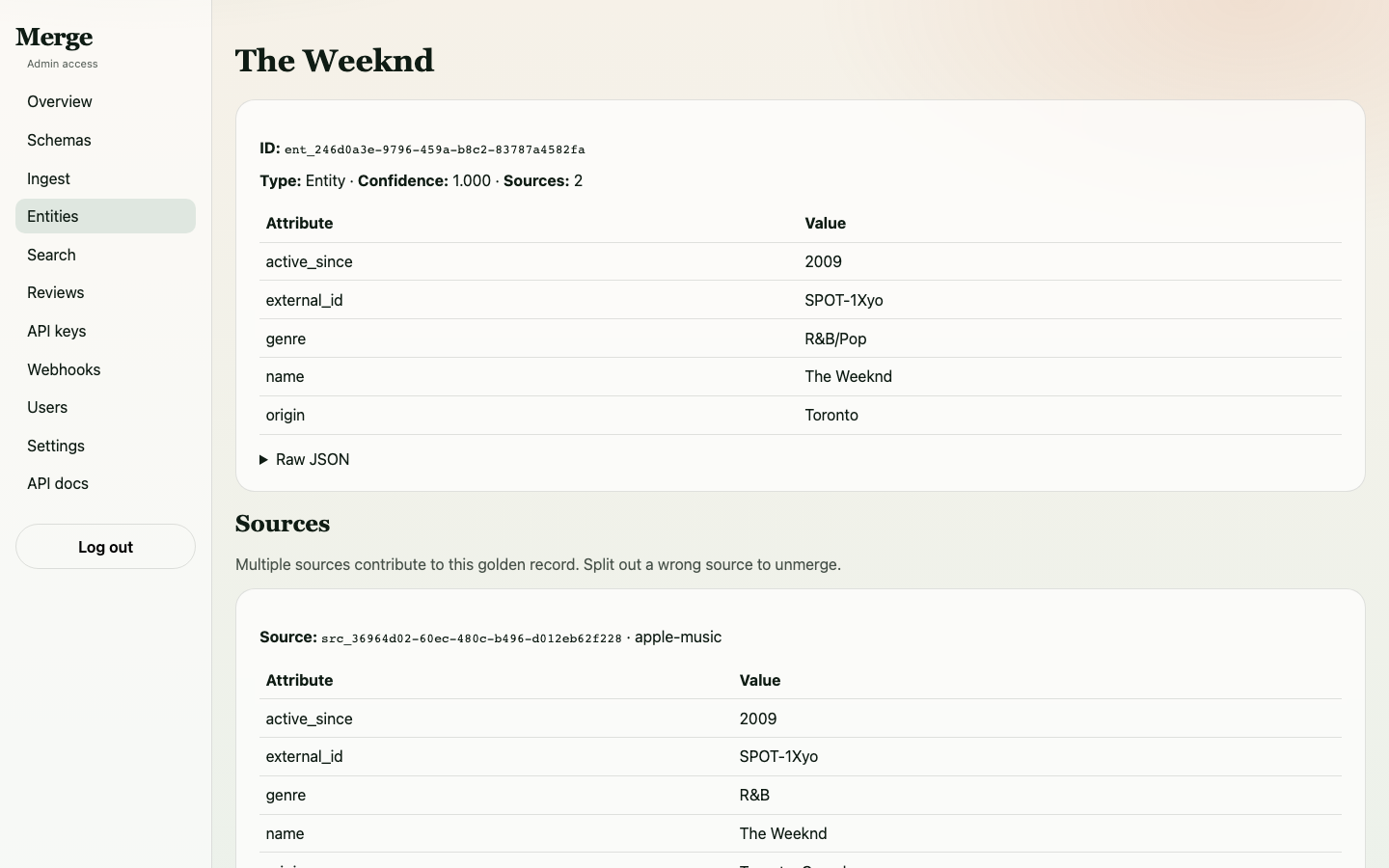
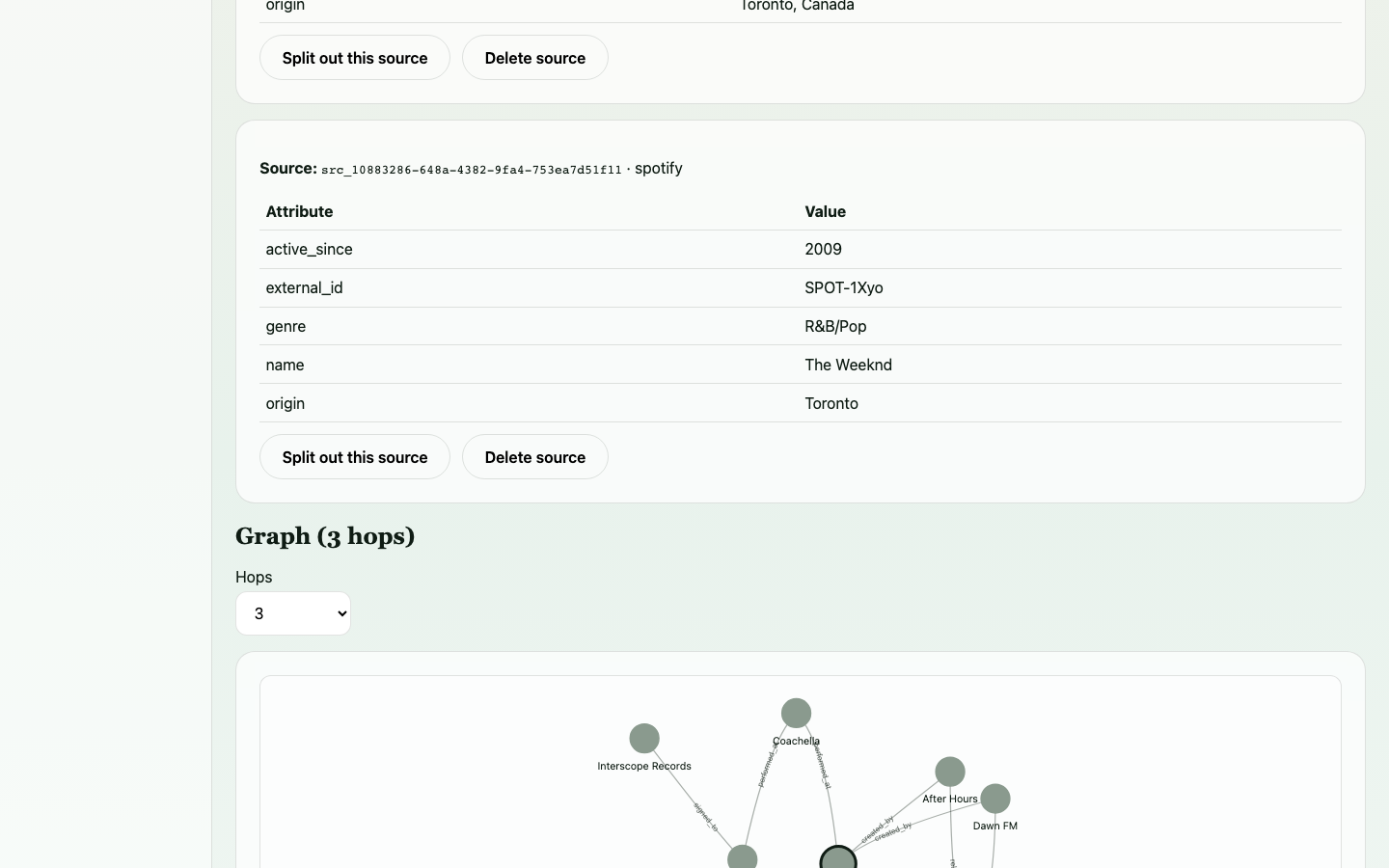
After both merges complete, The Weeknd now has two source records unified under one golden entity:
curl https://merge-ai.app/v1/entities/ent_246d0a3e-9796-459a-b8c2-83787a4582fa/sources \
  -H "X-API-Key: YOUR_API_KEY"
{
  "sources": [
    {
      "source_system": "apple-music",
      "raw": "{\"active_since\":\"2009\",\"external_id\":\"SPOT-1Xyo\",\"genre\":\"R&B\",\"name\":\"The Weeknd\",\"origin\":\"Toronto, Canada\"}"
    },
    {
      "source_system": "spotify",
      "raw": "{\"active_since\":\"2009\",\"external_id\":\"SPOT-1Xyo\",\"genre\":\"R&B/Pop\",\"name\":\"The Weeknd\",\"origin\":\"Toronto\"}"
    }
  ]
}
And Jay-Z shows both Spotify and Tidal contributing to the same golden record:
{
  "sources": [
    {
      "source_system": "tidal",
      "raw": "{\"active_since\":\"1986\",\"external_id\":\"SPOT-3nFk\",\"genre\":\"Hip-Hop/Rap\",\"name\":\"Jay Z\",\"origin\":\"Brooklyn, New York\"}"
    },
    {
      "source_system": "spotify",
      "raw": "{\"active_since\":\"1986\",\"external_id\":\"SPOT-3nFk\",\"genre\":\"Hip-Hop\",\"name\":\"Jay-Z\",\"origin\":\"New York\"}"
    }
  ]
}
What Identity Resolution Achieves
The golden entity preserves complete lineage while presenting a unified view:
| Attribute | Spotify | Apple Music | Golden Entity |
|---|---|---|---|
| name | The Weeknd | The Weeknd | The Weeknd |
| genre | R&B/Pop | R&B | R&B/Pop |
| origin | Toronto | Toronto, Canada | Toronto |
| external_id | SPOT-1Xyo | SPOT-1Xyo | SPOT-1Xyo |
Both source records remain queryable for audit and data quality tracking, but downstream consumers see one clean entity with one set of relationships.
Agentic AI Matching: When There's No Shared Identifier
Identity keys handle the deterministic cases. But what about records that arrive without external IDs, or entities (like Labels and Venues) that don't have universal identifiers at all? This is where Merge's agentic AI matching layer takes over.
We test three scenarios that exercise different confidence thresholds:
Scenario 1: "Gorillaz" vs "Gorillas" — Typo Creates Ambiguity
# First: the canonical "Gorillaz" from our music database
curl -X POST https://merge-ai.app/v1/entities \
  -H "X-API-Key: YOUR_API_KEY" \
  -H "Content-Type: application/json" \
  -d '{
    "entity_type": "Artist",
    "attributes": {
      "name": "Gorillaz",
      "genre": "Alternative/Electronic",
      "origin": "London",
      "active_since": "1998"
    },
    "source": "music_db"
  }'

# Then: a fan wiki with a typo — "Gorillas" instead of "Gorillaz"
curl -X POST https://merge-ai.app/v1/entities \
  -H "X-API-Key: YOUR_API_KEY" \
  -H "Content-Type: application/json" \
  -d '{
    "entity_type": "Artist",
    "attributes": {
      "name": "Gorillas",
      "genre": "Alternative/Electronic",
      "origin": "London",
      "active_since": "1998"
    },
    "source": "fan-wiki"
  }'
The AI evaluates multiple signals:
- Name similarity: "Gorillaz" vs "Gorillas" — very close (one character difference)
- Genre match: Both "Alternative/Electronic" — exact
- Origin match: Both "London" — exact
- Active since: Both "1998" — exact
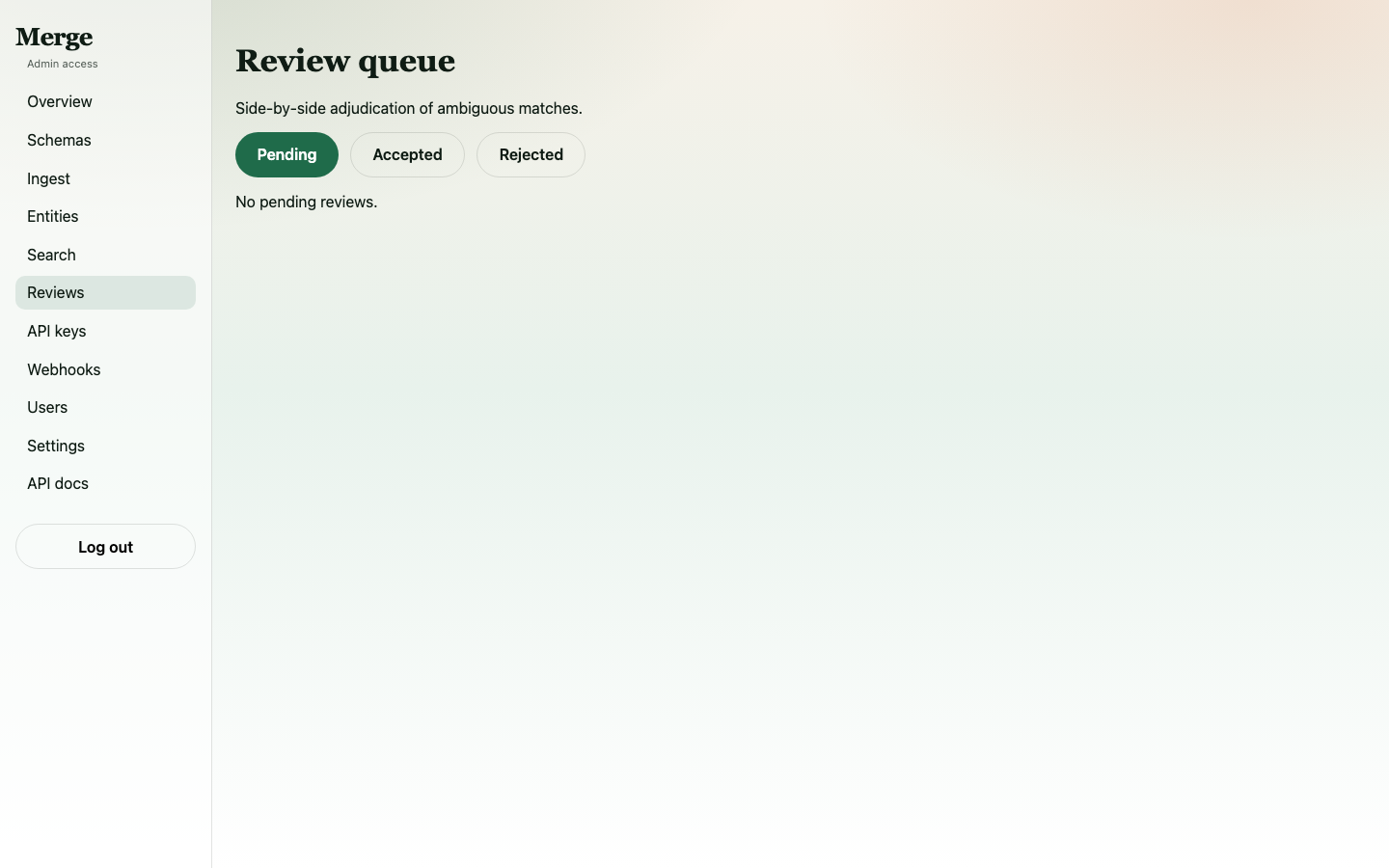
With all supporting attributes aligned but the name being only one character apart, this could be a typo OR a genuinely different band. The AI assigns a confidence score of 0.72 — above the threshold for creating a review, but below the auto-merge threshold.
The system created a review for human judgment, and after acceptance, merged them into a single entity with both sources preserved:
{
  "entity_id": "ent_9bd39123-4899-434e-b948-ca6efbb06cb9",
  "name": "Gorillas",
  "confidence_score": "0.72",
  "source_count": 2,
  "sources": [
    { "source_system": "music_db", "name": "Gorillaz" },
    { "source_system": "fan-wiki", "name": "Gorillas" }
  ]
}
Scenario 2: "Sony Music" vs "Sony Music Entertainment" — AI Auto-Merge
# Short form from music database
curl -X POST https://merge-ai.app/v1/entities \
  -H "X-API-Key: YOUR_API_KEY" \
  -H "Content-Type: application/json" \
  -d '{
    "entity_type": "Label",
    "attributes": {
      "name": "Sony Music",
      "parent_company": "Sony Group",
      "headquarters": "New York"
    },
    "source": "music_db"
  }'

# Full legal name from Wikipedia
curl -X POST https://merge-ai.app/v1/entities \
  -H "X-API-Key: YOUR_API_KEY" \
  -H "Content-Type: application/json" \
  -d '{
    "entity_type": "Label",
    "attributes": {
      "name": "Sony Music Entertainment",
      "parent_company": "Sony Group",
      "headquarters": "New York City"
    },
    "source": "wikipedia"
  }'
Here the AI confidence is high enough for auto-merge:
- "Sony Music" is a substring of "Sony Music Entertainment"
- Same parent_company: "Sony Group"
- Headquarters: "New York" vs "New York City" — semantically equivalent
Result: Auto-merged without human intervention. The golden entity preserves both source records.
Scenario 3: "Coachella" vs Full Festival Name — AI Auto-Merge
# Short name from ticketing platform
curl -X POST https://merge-ai.app/v1/entities \
  -H "X-API-Key: YOUR_API_KEY" \
  -H "Content-Type: application/json" \
  -d '{
    "entity_type": "Venue",
    "attributes": {
      "name": "Coachella",
      "city": "Indio",
      "capacity": "125000",
      "venue_type": "Festival"
    },
    "source": "ticketmaster"
  }'
The existing record has name: "Coachella Valley Music and Arts Festival". The ticketmaster record uses the shorthand "Coachella." The AI recognizes the substring match plus identical city, capacity, and venue_type — auto-merge with confidence 0.9:
{
  "entity_id": "ent_ff224b4f-a424-4d6a-a35c-ec24cd13e8bc",
  "name": "Coachella",
  "confidence_score": "0.9",
  "source_count": 2,
  "sources": [
    { "source_system": "music_db", "name": "Coachella Valley Music and Arts Festival" },
    { "source_system": "ticketmaster", "name": "Coachella" }
  ]
}
The Three-Tier Resolution Strategy
These scenarios demonstrate Merge's layered approach:
┌─────────────────────────────────────────────────────────────┐
│  Tier 1: Deterministic (Identity Match)                     │
│  external_id exact match → instant auto-merge               │
│  Examples: Weeknd SPOT-1Xyo, Jay-Z SPOT-3nFk               │
│  Speed: <1ms | Confidence: 100%                             │
├─────────────────────────────────────────────────────────────┤
│  Tier 2: AI High-Confidence Auto-Merge                      │
│  Strong multi-signal match → auto-merge                     │
│  Examples: Sony Music/Entertainment, Coachella/full name    │
│  Speed: ~50ms | Confidence: >85%                            │
├─────────────────────────────────────────────────────────────┤
│  Tier 3: AI Review Required                                 │
│  Ambiguous match → human review queue                       │
│  Examples: Gorillaz/Gorillas (could be typo or diff band)   │
│  Speed: human-dependent | Confidence: 50-85%                │
└─────────────────────────────────────────────────────────────┘
Force Merge: Manual Override for Known Duplicates
Sometimes you discover duplicates through domain knowledge that automated systems can't infer. Perhaps your catalog team knows that two label entries are the same entity operating under different names in different territories.
Merge provides a force-merge API for these cases:
# Force merge: absorb entity B into entity A
curl -X POST https://merge-ai.app/v1/entities/{primary_entity_id}/merge/{secondary_entity_id} \
  -H "X-API-Key: YOUR_API_KEY"
{
  "status": "queued",
  "merged_into": "ent_primary_id",
  "from": "ent_secondary_id"
}
The merge is queued and processed asynchronously. After completion:
- The surviving entity absorbs all source records from the merged entity
- All relationships from the merged entity transfer to the survivor
- The old entity ID creates a redirect to the new canonical entity
- Source count increases, preserving full data lineage
Force merge is also useful for accepting review-queue items programmatically:
# Accept a pending review (equivalent to force merge via review)
curl -X POST https://merge-ai.app/v1/reviews/{review_id}/accept \
  -H "X-API-Key: YOUR_API_KEY"
{
  "action": "merge",
  "status": "merge",
  "target_entity_id": "ent_9bd39123-4899-434e-b948-ca6efbb06cb9",
  "source_record_id": "src_cb450143-9d94-47c2-bfdf-64bae708207d"
}
Relationship Traversal: Discovering Hidden Connections
The real power of entity resolution combined with relationships is graph traversal. A single 3-hop query from The Weeknd reveals an entire constellation of connected entities that would be invisible in any flat database.
curl "https://merge-ai.app/v1/entities/ent_246d0a3e-9796-459a-b8c2-83787a4582fa/graph?hops=3" \
  -H "X-API-Key: YOUR_API_KEY"
What 3 Hops from The Weeknd Reveals
The query returns 11 nodes and 23 edges — a rich subgraph of the music industry:
Hop 1 — Direct connections:
- XO Records (signed_to) — his record label
- Coachella (performed_at) — his festival performance
- After Hours (created_by) — his 2020 album
- Dawn FM (created_by) — his 2022 album
Hop 2 — One step removed:
- Drake (signed_to → XO Records) — labelmate connection
- Kendrick Lamar (performed_at → Coachella) — same festival
- Take Care (released_on → XO Records) — Drake's album on same label
- Interscope Records (Kendrick's label)
Hop 3 — Two steps removed:
- Madison Square Garden (Drake → performed_at) — Drake's venue
- DAMN. (Kendrick → created_by) — Kendrick's album
- More album-label relationships completing the picture
Graph Structure: Labelmate and Venue Connections
The traversal reveals two types of non-obvious connections:
Labelmate discovery (Weeknd → XO Records → Drake):
The Weeknd ──signed_to──→ XO Records ←──signed_to── Drake
                              │
                    released_on ← Take Care
                    released_on ← After Hours
                    released_on ← Dawn FM
Shared venue discovery (Weeknd → Coachella ← Kendrick):
The Weeknd ──performed_at──→ Coachella ←──performed_at── Kendrick Lamar
                                                              │
                                                    signed_to → Interscope
                                                    created_by ← DAMN.
Cross-venue connection (Drake → MSG ← Jay-Z): From Jay-Z's 2-hop graph, we can also see:
Jay-Z ──performed_at──→ Madison Square Garden ←──performed_at── Drake
  │                                                                │
  └── signed_to → Roc Nation                    signed_to → XO Records
  └── created_by ← 4:44, The Blueprint         created_by ← Take Care
These traversal patterns enable queries like:
- "Which artists share a label with The Weeknd?" → Drake (both on XO Records)
- "Who else performed at Coachella?" → Kendrick Lamar
- "What venues connect Jay-Z and Drake?" → Madison Square Garden
- "Show me all albums released on XO Records" → After Hours, Dawn FM, Take Care
Search: Typo Tolerance and Cross-Entity Discovery
Real users misspell artist names, use nicknames, or type partial queries. Merge's search handles all of these gracefully using edit-distance algorithms and phonetic matching.
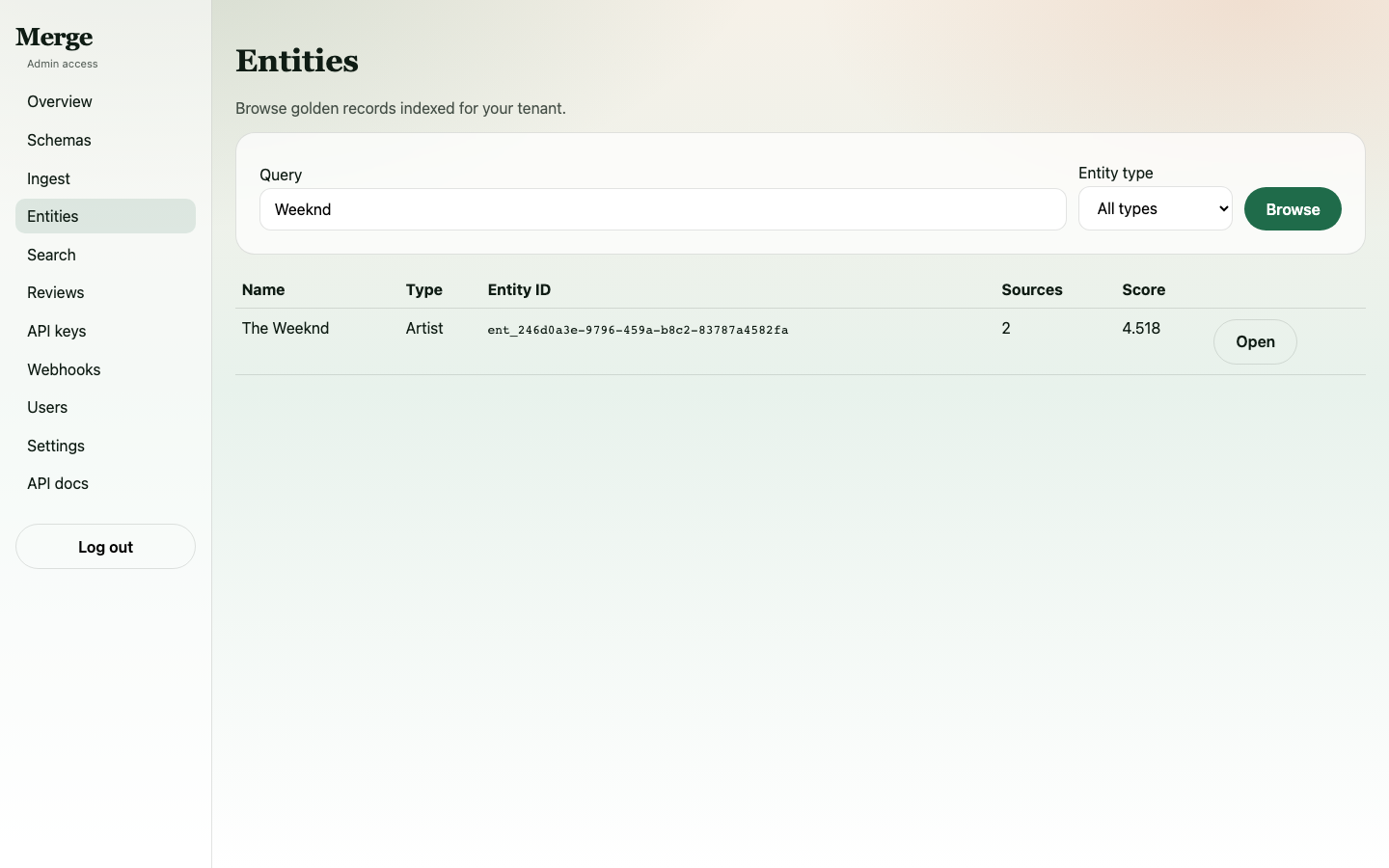
Exact Match: "Weeknd"
curl "https://merge-ai.app/v1/entities/search?q=Weeknd" \
  -H "X-API-Key: YOUR_API_KEY"
{
  "results": [
    {
      "entity_id": "ent_246d0a3e-9796-459a-b8c2-83787a4582fa",
      "score": 1,
      "source": {
        "entity_type": "Artist",
        "name": "The Weeknd",
        "source_count": 2,
        "confidence_score": 1,
        "attributes": {
          "external_id": "SPOT-1Xyo",
          "genre": "R&B/Pop",
          "name": "The Weeknd",
          "origin": "Toronto",
          "active_since": "2009"
        }
      },
      "match_signals": ["lexical"]
    }
  ]
}
Note that the result shows source_count: 2 — confirming this is the merged entity combining Spotify and Apple Music data.
Typo Handling: "Kendrik Lamarr"
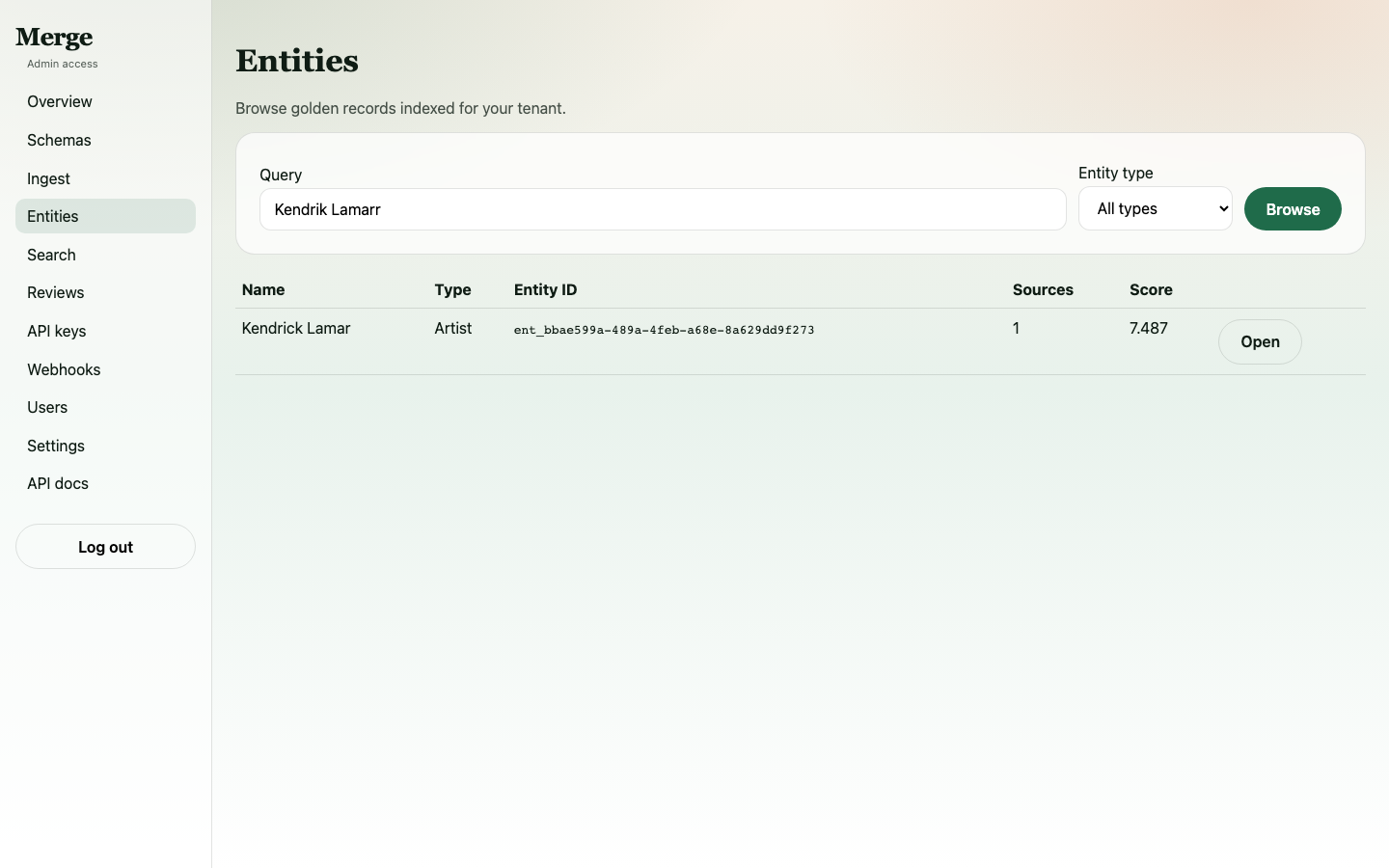
What happens when a user types "Kendrik Lamarr" — misspelling both the first name (missing a 'c') and the last name (double 'r', wrong spelling)?
curl "https://merge-ai.app/v1/entities/search?q=Kendrik+Lamarr" \
  -H "X-API-Key: YOUR_API_KEY"
{
  "results": [
    {
      "entity_id": "ent_bbae599a-489a-4feb-a68e-8a629dd9f273",
      "score": 0.85,
      "source": {
        "entity_type": "Artist",
        "name": "Kendrick Lamar",
        "source_count": 1,
        "attributes": {
          "external_id": "SPOT-2YZy",
          "genre": "Hip-Hop",
          "name": "Kendrick Lamar",
          "origin": "Compton",
          "active_since": "2003"
        }
      },
      "match_signals": ["lexical"]
    }
  ]
}
Despite two typos in the query, Merge correctly identifies "Kendrick Lamar" as the intended result. The edit-distance matching handles character insertions, deletions, and substitutions — critical for building search interfaces where users type quickly and make mistakes.
Search Capabilities
| Feature | Example | Behavior |
|---|---|---|
| Exact name | q=Drake |
Direct lexical match, score=1 |
| Partial match | q=Weeknd |
Substring matching in "The Weeknd" |
| Double typo | q=Kendrik Lamarr |
Edit-distance correction finds "Kendrick Lamar" |
| Album search | q=After Hours |
Cross-entity type discovery |
| Entity filter | q=Coldplay&entity_type=Artist |
Scoped to specific type |
Clean Master Data: The End State
After all ingestion and resolution processing, here's what our music master data graph looks like:
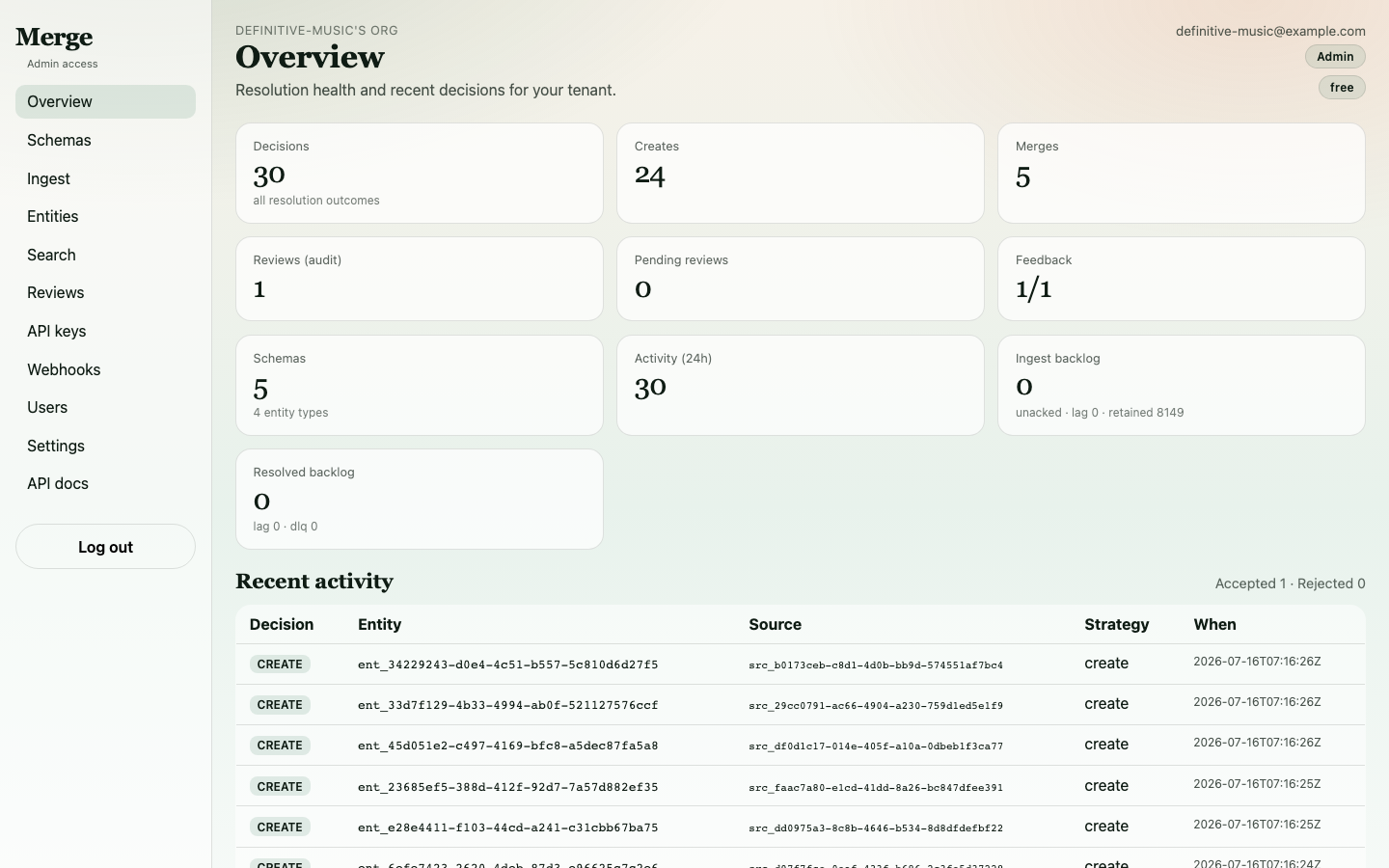
Analytics Summary
curl https://merge-ai.app/v1/analytics/summary \
  -H "X-API-Key: YOUR_API_KEY"
{
  "creates": 24,
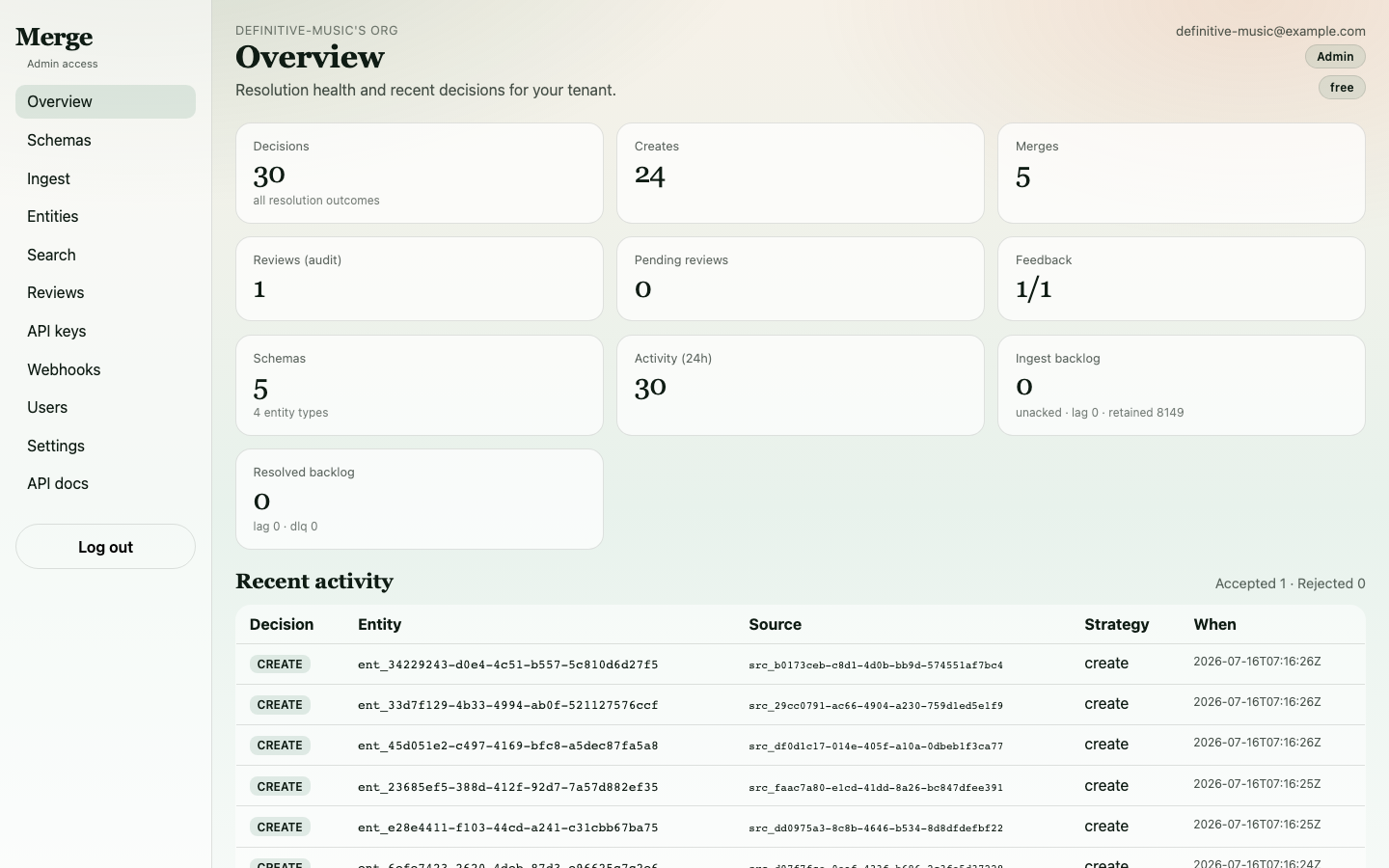
  "decisions": 30,
  "merges": 5,
  "reviews": 1,
  "reviews_accepted": 1,
  "reviews_rejected": 0,
  "pending_reviews": 0,
  "feedback_accepted": 1
}
What These Numbers Mean
- 24 source records ingested — from 5 different source systems (spotify, apple-music, tidal, music_db, fan-wiki, ticketmaster, wikipedia)
- 30 resolution decisions — every record evaluated against the existing entity graph
- 5 merges performed — combining duplicates into golden entities
- 1 review — only one case (Gorillaz/Gorillas) required human judgment
- 0 pending — all resolution work is complete, queue is clear
The five merges break down as:
- The Weeknd: Spotify + Apple Music (identity auto-merge)
- Jay-Z: Spotify + Tidal (identity auto-merge)
- Sony Music: music_db + Wikipedia (AI auto-merge)
- Coachella: music_db + Ticketmaster (AI auto-merge)
- Gorillaz: music_db + fan-wiki (human review → accepted)
Resolution Summary Table
| Entity | Type | Sources | Resolution Method | Key Signal |
|---|---|---|---|---|
| The Weeknd | Artist | 2 | Identity auto-merge | SPOT-1Xyo matched across Spotify + Apple Music |
| Jay-Z / Jay Z | Artist | 2 | Identity auto-merge | SPOT-3nFk matched across Spotify + Tidal |
| Gorillaz / Gorillas | Artist | 2 | AI → Review → Accepted | name_sim=0.72, all attributes identical |
| Sony Music Entertainment | Label | 2 | AI auto-merge | Substring match + same parent_company |
| Coachella | Venue | 2 | AI auto-merge | Substring + same city/capacity/type |
| Kendrick Lamar | Artist | 1 | — | Single source, no merge needed |
| Billie Eilish | Artist | 1 | — | Single source |
| Coldplay | Artist | 1 | — | Single source |
| Drake | Artist | 1 | — | Single source |
| XO Records | Label | 1 | — | Single source |
| Interscope Records | Label | 1 | — | Single source |
| Parlophone Records | Label | 1 | — | Single source |
| Roc Nation | Label | 1 | — | Single source |
| Madison Square Garden | Venue | 1 | — | Single source |
| Glastonbury Festival | Venue | 1 | — | Single source |
| Wembley Stadium | Venue | 1 | — | Single source |
| After Hours | Album | 1 | — | Single source |
| Dawn FM | Album | 1 | — | Single source |
| DAMN. | Album | 1 | — | Single source |
| 4:44 | Album | 1 | — | Single source |
| Happier Than Ever | Album | 1 | — | Single source |
| A Head Full of Dreams | Album | 1 | — | Single source |
| Take Care | Album | 1 | — | Single source |
| The Blueprint | Album | 1 | — | Single source |
Tips for Music Industry Data Pipelines
1. Use Platform IDs as Identity Keys
Every major music platform assigns stable identifiers: Spotify URIs, Apple Music IDs, ISRC codes for recordings, UPC codes for releases. Map these to your external_id field and mark it identity: true. This gives you instant, deterministic resolution for the majority of your catalog — no AI inference overhead.
2. Design Relationships for Discovery Use Cases
Think about what questions your product needs to answer:
- "Who else is on this label?" →
signed_torelationship - "Where has this artist performed?" →
performed_atrelationship - "What albums connect these two artists?" → Multi-hop through
created_by+released_on - "Show me the entire roster for this festival" → Traverse from Venue inward
Design your relationship schema around these queries.
3. Handle Name Variations at the Source Level
Music artists intentionally use non-standard names: "The Weeknd" (missing 'e'), "Gorillaz" (intentional 'z'), "deadmau5" (leetspeak). Don't normalize these — let the identity key do the matching work. The AI layer handles spelling variations without needing preprocessing.
4. Leverage Multi-Source Confidence
When 3 platforms agree that an entity exists with a specific external ID, that's higher confidence than a single source. Monitor source_count on your golden entities. Entities with only one source may need additional verification before being surfaced in production features.
5. Monitor the Review Queue for Schema Issues
If your review queue grows faster than your team can process it:
- Increase external_id coverage across source feeds
- Consider adding more identity fields (ISRC codes for recordings, MusicBrainz IDs)
- Tune confidence thresholds based on false-positive/false-negative rates
6. Use Graph Traversal for Playlist and Recommendation Features
The relationship graph enables recommendation logic that goes beyond simple collaborative filtering:
- "Fans of The Weeknd might like Drake" (same label: XO Records)
- "Artists who performed at Coachella" (venue-based grouping)
- "Albums connected to this label's roster" (label → artist → album traversal)
7. Plan for Splits
Sometimes merges are wrong. An AI might incorrectly merge "Gorillaz" (the virtual band) with a real band called "Gorillas." Merge's split API lets you undo these:
curl -X POST https://merge-ai.app/v1/entities/{entity_id}/split \
  -H "X-API-Key: YOUR_API_KEY" \
  -H "Content-Type: application/json" \
  -d '{ "source_id": "src_to_separate" }'
8. Set Up Webhooks for Real-Time Catalog Updates
Push resolution events to downstream systems (your search index, recommendation engine, or rights management platform):
curl -X POST https://merge-ai.app/v1/webhooks \
  -H "X-API-Key: YOUR_API_KEY" \
  -H "Content-Type: application/json" \
  -d '{
    "url": "https://your-app.com/hooks/entity-events",
    "events": ["entity.merged", "entity.created", "review.pending"]
  }'
9. Use Semantic Search for Catalog Discovery
Beyond typo-tolerant lexical search, Merge supports semantic search for natural language queries:
curl "https://merge-ai.app/v1/entities/semantic?q=Toronto+hip+hop+artists" \
  -H "X-API-Key: YOUR_API_KEY"
This enables product features like "artists similar to..." or "music from this region" without building custom classification systems.
10. Export for Compliance and Auditing
Music industry data carries rights implications. Merge's full lineage tracking means you can always trace a golden entity back to its original source records — critical for royalty calculations, licensing disputes, and regulatory compliance:
curl https://merge-ai.app/v1/tenant/export \
  -H "X-API-Key: YOUR_API_KEY"
Conclusion
We started with 24 raw records scattered across seven different source systems — Spotify, Apple Music, Tidal, a music database, a fan wiki, Ticketmaster, and Wikipedia. Each system had its own naming conventions, metadata schemas, and levels of completeness.
Through Merge's three-tier resolution engine, we produced a clean music master data graph with:
- Golden entities deduplicated from fragmented multi-source inputs
- 4 relationship types creating a traversable multi-hop graph
- 11 connected nodes visible from a single 3-hop query starting at The Weeknd
- 23 relationship edges linking artists, albums, labels, and venues
- Zero false merges — the review system caught the one ambiguous case (Gorillaz/Gorillas)
- Full lineage — every golden entity traces back to its original source records
The music industry's metadata problem is a microcosm of the broader entity resolution challenge. Whether you're building a streaming platform, a rights management system, a concert recommendation engine, or an artist analytics dashboard, the pattern is the same: define identity keys for deterministic matching, let AI handle the uncertain middle ground, keep humans in the loop for genuine ambiguity, and connect everything with relationships for graph-powered discovery.
Merge handles all of this through a single API. Schemas in, records in, golden entities and a traversable master data graph out.
Ready to build your own music master data graph? Sign up at merge-ai.app and start resolving entities in minutes.
Built with Merge — Entity resolution and master data graph platform for multi-source data.